
Editor’s Note: This article was updated in September 2025 to expand coverage, include new examples, and improve SEO performance.
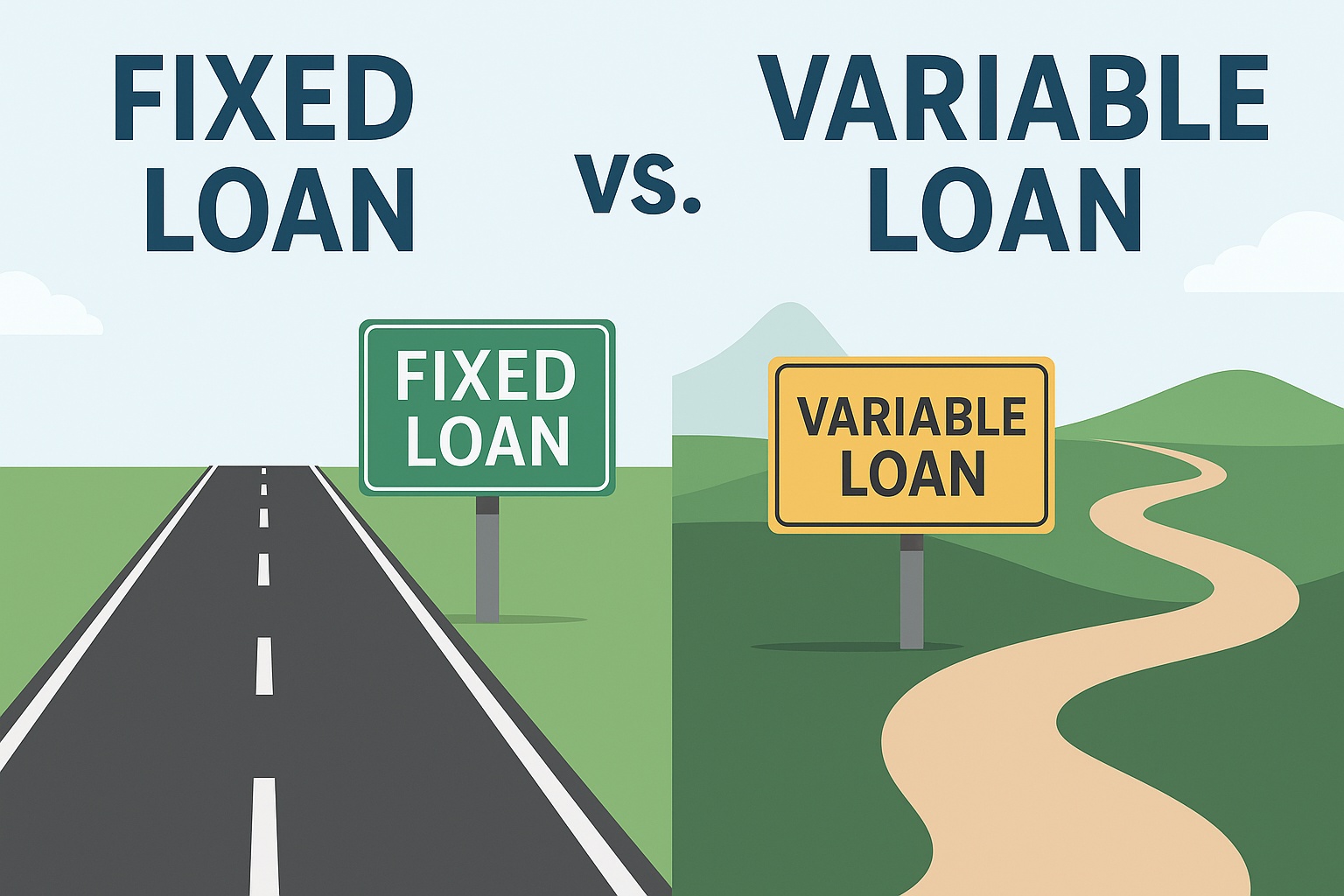
Fixed loans offer a steady path, while variable loans may twist with market conditions.
Small business owners often compare fixed vs variable interest rates when choosing a loan. That decision reshapes payment stability, total interest cost, and cash flow. This guide explains how both rate types work, why they differ, and how to select the structure that fits your business goals.
What are fixed vs variable interest rates?
A fixed interest rate stays the same for the entire term. Your payment does not change with market moves. Predictable payments reduce stress and simplify budgeting.
A variable interest rate changes over time. The rate tracks a benchmark index plus a margin. Lenders frequently use the prime rate or SOFR as the index. When the index rises, payments usually rise; when it falls, payments can decline.
At a glance, fixed vs variable interest rates trade certainty for potential savings. Fixed buys stability. Variable buys flexibility with added risk.

Fixed vs variable interest rates at a glance
| Feature | Fixed Rate Loan | Variable Rate Loan |
|---|---|---|
| Payment stability | Stable and predictable | Can change at each reset |
| Exposure to rising rates | Low | Higher |
| Typical starting rate | Often higher | Often lower |
| Potential savings if rates fall | Limited | Possible |
| Best fit | Long-term certainty, tight margins | Short timeline, refinance plan, rate-drop view |
Pros and cons of fixed vs variable interest rates
Fixed rate advantages
- Predictable payments: Easier planning and simpler cash-flow management.
- Protection from spikes: Insulated from sudden increases in benchmark rates.
- Clear total cost: Long-term expense is easier to estimate.
Fixed rate tradeoffs
- Higher starting rate: You pay a premium for certainty.
- No automatic savings: Falling rates do not reduce your payment.
- Refinance to change: Adjustments usually require new fees and underwriting.
Variable rate advantages
- Lower entry rate: Can reduce initial payment burden, improving near-term cash flow.
- Upside if benchmarks fall: Adjustments may lower interest cost.
- Potential conversion: Some contracts allow switching to fixed later.
Variable rate tradeoffs
- Payment uncertainty: Budgeting is harder when rates move.
- Rate-spike risk: Rising benchmarks can strain margins.
- Monitoring burden: You must watch resets, caps, and covenants.
How fixed vs variable interest rates work in practice
Assume a $100,000, five-year amortizing loan.
- Fixed at 5.5%: Payment stays the same for five years. Total interest remains predictable.
- Variable starting at 4.5%: If the index rises 1.5 percentage points in year two, your rate increases at the next reset. Over five years, total interest can surpass the fixed option, even though the starting rate was lower.
The lesson is simple: a lower initial quote does not guarantee a lower total cost. Always test scenarios with higher benchmarks.
Four decision drivers for business owners
- Cash-flow cushion: Thin margins favor fixed payments and certainty.
- Loan horizon: Short timelines pair well with variable rates if you expect to refinance.
- Market view: Expecting declines supports variable; expecting hikes supports fixed.
- Contract guardrails: Know the index, margin, reset frequency, caps, floors, and prepayment terms.
Risk management with variable rates
- Choose sensible caps: Lifetime and periodic caps limit extreme payment jumps.
- Build a buffer: Reserve one to three months of payments for adverse moves.
- Time your resets: Annual resets move slower than monthly resets.
- Keep Plan B: Maintain eligibility to refinance or convert to fixed if volatility rises.
When fixed usually wins
- You need stable payments to protect payroll and operations.
- Your loan is long term, and surprises would strain the business.
- You expect rates to rise or stay elevated for a while.
When variable can make sense
- Your timeline is short, and you plan to refinance or repay early.
- You believe benchmarks will fall and can tolerate interim movement.
- Your contract includes reasonable caps and clean conversion language.
Helpful resources on fixed vs variable interest rates
Investopedia: Fixed vs Variable Rate Loans — plain-English fundamentals and examples.
U.S. Small Business Administration: Interest Rates — current SBA loan information and context.
Related guides on Business Loan Press
APR vs Interest Rate: What Borrowers Should Compare — learn why APR shows true cost.
How to Qualify for a Small Business Loan — practical steps to strengthen applications.
Bottom line
Fixed vs variable interest rates reflect a tradeoff. Fixed rates offer certainty at a possibly higher starting price. Variable rates offer flexibility and potential savings but demand risk tolerance and a backup plan. Choose the structure that works under stress, not just under today’s quote. Model a few scenarios, confirm caps, and align the decision with your timeline and cash-flow resilience.
Feature and inline images created by AI illustration tools and converted to JPEG for Business Loan Press.
Additional image courtesy of Pixabay.