
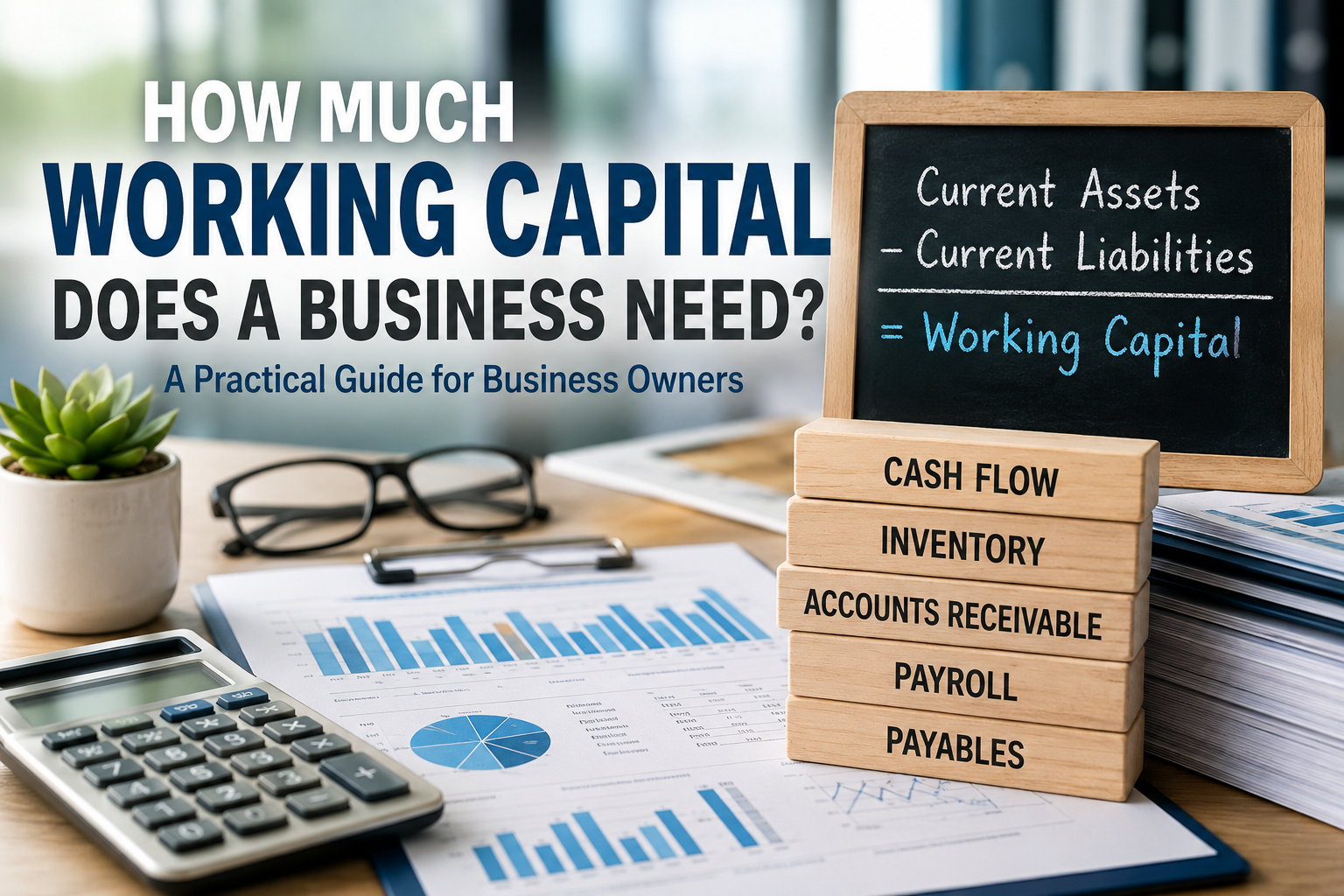
How much working capital does a business need? There is no single dollar amount or rule of thumb that works for every company. A business that collects payment immediately and carries little inventory may need a much smaller cushion than one that buys inventory months before a seasonal selling period or routinely waits 30 to 60 days for customers to pay.
The goal is not simply to accumulate as much cash as possible. A business needs enough working capital to pay its short-term obligations while money remains tied up in normal operations. It also needs some room for slower sales, delayed payments, or unexpected expenses.
What Working Capital Actually Measures
At its simplest, working capital is the difference between a company’s current assets and current liabilities. Current assets generally include cash, accounts receivable, inventory, and other assets the business expects to convert to cash relatively soon. Current liabilities include accounts payable, short-term debt, accrued expenses, and other bills coming due.
If a company has $150,000 in current assets and $100,000 in current liabilities, it has $50,000 in working capital. That calculation is useful, but it does not tell the entire story. Two businesses with exactly $50,000 in working capital can have very different levels of financial flexibility.
One business may hold most of its current assets in cash. Another may have much of its money tied up in slow-moving inventory and unpaid invoices. On paper, their working capital is the same; in practice, their ability to meet next week’s payroll may be very different.
How Much Working Capital Does a Business Need?
The answer depends heavily on how quickly money moves through the business. Instead of beginning with an arbitrary target such as three months or six months of expenses, start by identifying when the company must spend cash and when it can reasonably expect that cash to return.
A neighborhood service business that receives payment when work is completed may have a short operating cycle. A wholesaler, manufacturer, or seasonal retailer may pay suppliers well before inventory sells. It may then wait even longer for customers to pay.
The second company generally needs more working capital to bridge that gap. This is closely related to the cash conversion cycle, which shows how long money remains tied up in inventory and receivables. Understanding that cycle can explain why a profitable company sometimes struggles to pay bills on time.
Start With the Cash Your Business Must Have Available
Begin with expenses that cannot simply wait when cash runs short. Payroll, rent, utilities, insurance, taxes, supplier payments, and debt obligations continue even when customers pay slowly or sales temporarily decline.
Estimate those obligations over the period when your business is most likely to experience a cash-flow gap. For some companies, that may be several weeks. For seasonal businesses or companies with long customer-payment cycles, the relevant period may stretch across several months.
Next, compare those obligations with the cash already available and the money you reasonably expect to collect during the same period. The difference provides a much more useful starting point than annual revenue alone.
Do Not Treat Every Current Asset as Available Cash
One common mistake is assuming that all current assets provide the same protection against a cash shortage. They do not. Cash in a bank account can pay tomorrow’s bills, while the business must sell inventory or collect receivables before it can use that money.
Consider a business with $80,000 in current assets. If inventory and unpaid customer invoices account for $60,000, only a fraction may be immediately available for payroll or an unexpected repair. The balance sheet may look healthy even while the checking account runs uncomfortably low.
Business owners should therefore look beyond the working-capital calculation and examine what makes up their current assets. Aging receivables and slow-moving or excess inventory can make reported working capital less useful than it first appears.
Receivables Can Increase Your Working-Capital Need
A sale does not help today’s cash position if the customer will not pay for another 45 days. Businesses that extend credit often have to cover payroll, suppliers, rent, and other expenses before collecting the revenue tied to those costs.
The longer customers take to pay, the more cash the company may need to bridge the interval. A growing company can feel this pressure even more strongly because it may fund increasing amounts of work before receiving payment for earlier sales.
Reviewing an accounts receivable aging report can help identify how much money is likely to arrive soon. Our discussion of accounts receivable problems also explains how slow collections can affect cash flow and a lender’s assessment of the business.
Inventory Can Tie Up More Cash Than You Realize
Inventory creates a similar problem. The business spends cash before the product generates revenue, and that money remains unavailable until the inventory sells and the customer pays.

Seasonal businesses can face an especially large working-capital requirement because they may build inventory well before their strongest sales period. A retailer preparing for holiday demand, for example, might make substantial purchases while still paying normal operating expenses.
More inventory is not automatically better. Excess or slow-moving inventory can absorb cash without producing enough revenue to justify the investment. When estimating how much working capital a business needs, use realistic inventory turnover rather than assuming every item will sell on schedule.
Seasonality Changes the Calculation
An annual average can hide the period when a business is most vulnerable. A company may generate adequate cash over the full year while experiencing predictable shortages during particular months.
A month-by-month cash-flow projection can reveal those tighter periods. Look for months when inventory purchases increase, sales decline, tax payments come due, insurance premiums renew, or customers historically take longer to pay.
The working-capital target should help carry the business through those periods. A company that bases its cushion only on its strongest months may discover a shortage exactly when additional cash becomes most important.
Growth Can Increase Working-Capital Pressure
Rapid growth sounds like the opposite of a cash-flow problem, but it can create one. Growth often requires the company to buy more inventory, hire employees, or increase production. Those expenses may come due well before new customers pay.
Suppose a contractor wins several large projects at once. Revenue may be heading sharply higher, but workers and suppliers may need payment weeks before customers make their first substantial payments. The company can become more profitable and more cash-constrained at the same time.

This is why working-capital planning should accompany expansion decisions. Growth that requires a larger investment in receivables, inventory, or payroll may also require a larger liquidity cushion.
Add a Cushion for What Will Not Go According to Plan
A working-capital estimate based entirely on expected results leaves little room for normal business uncertainty. Customers sometimes pay late. Equipment fails, suppliers raise prices, sales soften, and expenses arrive earlier than expected.
After estimating the company’s normal cash requirement, test the numbers under less favorable conditions. Consider what would happen if sales fell for a month or a major customer paid 30 days late. Also consider slower inventory sales or an unexpected equipment repair.
The goal is not to prepare financially for every possible disaster. Instead, determine whether an ordinary setback would immediately force the business to delay bills, use personal funds, or seek emergency financing.
A Simple Way to Estimate Your Working-Capital Requirement
A practical estimate does not require an elaborate financial model. Start with the period when your business is most likely to experience a cash gap. Then compare the money you expect to receive with the obligations coming due.
- Calculate essential operating expenses during that period.
- Include scheduled debt payments, taxes, insurance, and other obligations outside ordinary monthly expenses.
- Determine how much you must spend on inventory or other purchases before the related sales occur.
- Project the customer payments you can reasonably expect to collect during the same period.
- Subtract the operating cash the business already has available.
- Allow a reasonable cushion for slower collections, weaker sales, or unexpected expenses.
For example, assume a business expects $75,000 in essential cash obligations over the next three months and expects to collect $55,000. With $10,000 in available operating cash, the initial gap is $10,000. The owner can then decide how much additional cushion the business needs for its particular risks.
This is an operating estimate rather than a universal accounting formula. Its value comes from showing when money will actually enter and leave the business.
When Too Little Working Capital Becomes a Warning Sign
A business does not have to miss payments before inadequate working capital becomes visible. Warning signs can include repeatedly delaying supplier payments, using personal credit cards for routine expenses, or waiting for customer checks before making payroll. Frequent borrowing to cover ordinary bills can signal the same problem.
Existing debt can intensify the pressure because loan payments compete with operating expenses for the same cash. Maintaining an accurate business debt schedule helps show how much money the company has already committed before taking on another financing obligation.
A persistent shortage deserves more attention than a temporary timing problem. If normal operations continually consume more cash than they generate, additional working capital may postpone the problem rather than correct it.
When Financing Working Capital Can Make Sense
Borrowing can make sense when the company faces a genuine timing gap and can identify a reasonable source of repayment. A seasonal business may need inventory before its strongest sales period. A company with reliable commercial customers may need cash while waiting for invoices to arrive.
A revolving line of credit can be useful when working-capital needs rise and fall. SBA-backed working-capital financing can provide revolving credit for eligible businesses, including financing tied to receivables, inventory, contracts, and other operating needs.
The Federal Reserve’s 2026 Report on Employer Firms also shows how often businesses seek financing for day-to-day needs. Among firms that sought financing in the prior 12 months, 56% listed operating expenses as one reason they applied.
Financing still has to be repaid. Before borrowing, the company should identify how the funds will help generate or release the cash needed for repayment. If another loan only covers bills the business routinely cannot afford, the underlying problem may involve operating performance rather than working-capital timing.
Can a Business Have Too Much Working Capital?
More working capital is not always an advantage if inefficient assets create the higher number. Excess inventory, large overdue receivables, or cash sitting idle without a business purpose can increase working capital on paper without strengthening operations to the same degree.
The objective is not to maximize the working-capital number. Instead, a business should maintain enough accessible liquidity to operate reliably while using its resources productively.
That distinction is important when asking how much working capital does a business need. The best answer is not necessarily the largest amount the company can accumulate or borrow. It is the amount that supports normal operations, anticipated growth, and reasonable setbacks without leaving too much capital unnecessarily tied up.
Recalculate as the Business Changes
A working-capital target should change as the business changes. Hiring employees, adding a major customer, extending longer payment terms, carrying more inventory, taking on debt, or entering a new seasonal cycle can all affect the amount of cash the company needs.
Review the calculation after substantial changes and compare projections with what actually happened. If customers consistently pay later than expected or inventory turns more slowly, update the assumptions rather than relying on an outdated target.
For many businesses, the most useful question is not whether working capital meets a generic benchmark. The better question is whether the company has enough accessible cash and near-term collections to meet its obligations through the most demanding part of its operating cycle.
The Bottom Line
How much working capital does a business need? Enough to bridge the gap between paying the company’s obligations and collecting the cash generated by its operations. The business also needs a reasonable cushion for the things that will not happen exactly as planned.
Start with actual cash timing rather than an arbitrary rule of thumb. Examine receivables, inventory, essential expenses, debt payments, seasonality, and upcoming obligations together. That produces a working-capital target based on the way your business actually operates rather than a number borrowed from someone else’s company.
Sources
- U.S. Small Business Administration: SBA Lenders and Working Capital Pilot
- U.S. Small Business Administration: 7(a) Loans and Working Capital Pilot
- Federal Reserve Banks: 2026 Report on Employer Firms
- Federal Reserve Board: Small Business Financing
Financial Information Disclaimer
This article provides general educational information. It does not provide financial, legal, tax, accounting, or lending advice. Business owners should review their individual financial circumstances and consult qualified professionals when appropriate.
Amazon Affiliate Disclosure: As an Amazon Associate, we may earn from qualifying purchases without any additional cost to you.
Photo Credit: All images © Sloan Digital Publishing and licensed stock sources. Used with permission.